Prepared July 2026 · Based on a snapshot of the TNBC Atlas evidence library (last refreshed June 2026) · Analysis is directional, not a systematic review — see Methods & caveats.
The library at a glance
The bibliography is indexed across PubMed, Europe PMC, and OpenAlex and enriched with Crossref, Unpaywall, and Retraction Watch. Annual output has grown steadily and remains near its all-time high — the field is large, active, and fast-moving, which makes the choice of where to focus consequential. Notably, fewer than half of all TNBC papers are freely readable, a barrier this open platform helps close.
Reading the landscape
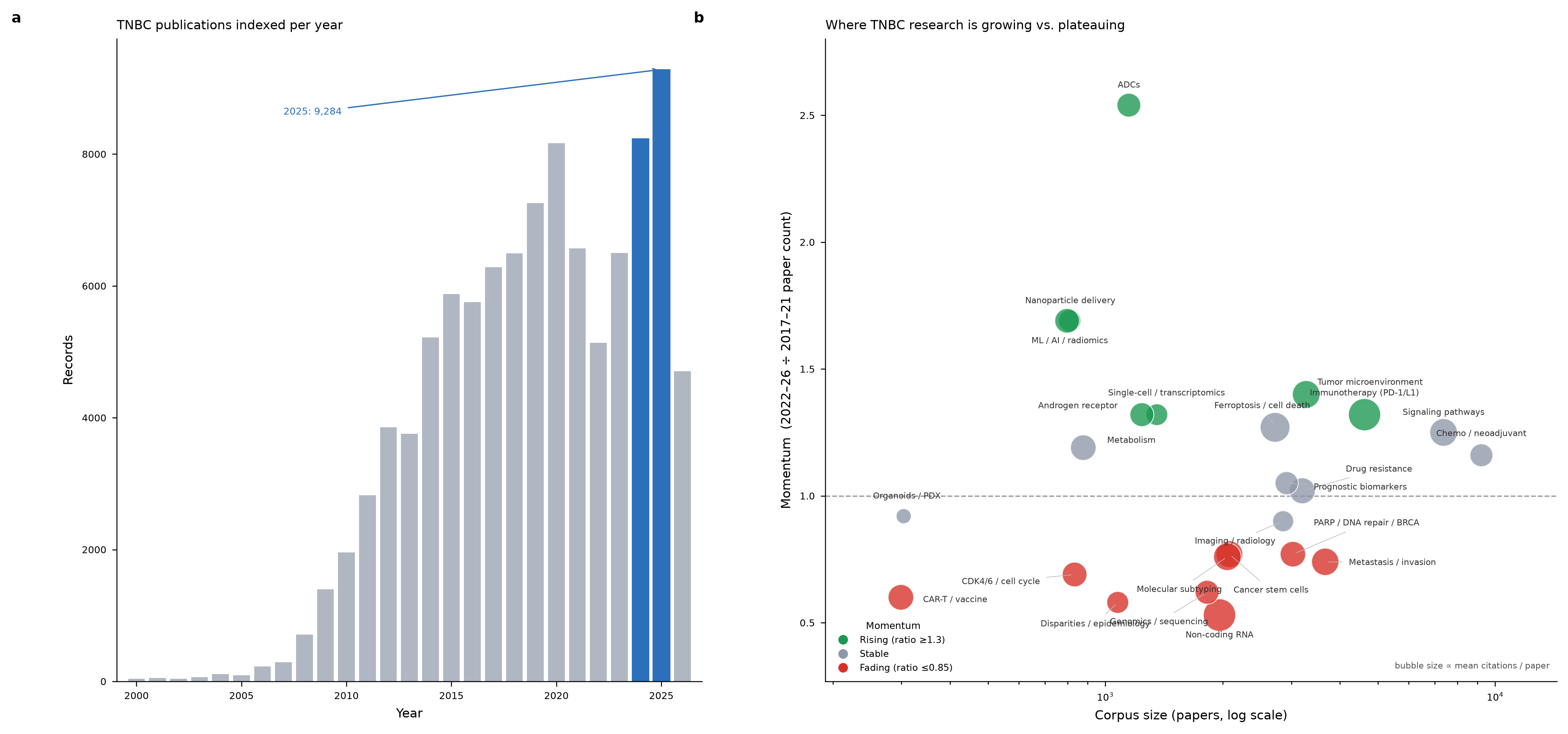
Rising (recent output ≥1.3× prior window) Stable Fading (≤0.85×)
Research themes, ranked by size and momentum
| Research theme | Papers | 2022–26 | Momentum | Mean cites |
|---|---|---|---|---|
| Chemotherapy / neoadjuvant | 9,217 | 3,136 | 1.16× | 8.0 |
| Signaling pathways | 7,371 | 3,021 | 1.25× | 12.2 |
| Immunotherapy (PD-1 / PD-L1) | 4,622 | 2,459 | 1.32× | 17.1 |
| Metastasis / invasion | 3,665 | 1,021 | 0.74× | 11.9 |
| Tumor microenvironment / immune infiltrate | 3,275 | 1,656 | 1.40× | 12.2 |
| Drug resistance | 3,200 | 1,253 | 1.02× | 10.6 |
| PARP inhibitors / DNA repair / BRCA | 3,028 | 951 | 0.77× | 10.2 |
| Prognostic biomarkers | 2,918 | 1,094 | 1.05× | 8.2 |
| Imaging / radiology | 2,858 | 895 | 0.90× | 6.5 |
| Ferroptosis / regulated cell death | 2,725 | 1,202 | 1.27× | 14.4 |
| Cancer stem cells | 2,081 | 623 | 0.77× | 11.4 |
| Molecular subtyping / classification | 2,056 | 546 | 0.76× | 12.2 |
| Non-coding RNA (miRNA / lncRNA / circRNA) | 1,963 | 549 | 0.53× | 17.3 |
| Genomics / mutation / sequencing | 1,824 | 504 | 0.62× | 8.8 |
| Single-cell / spatial transcriptomics | 1,356 | 592 | 1.32× | 7.0 |
| Androgen receptor | 1,241 | 410 | 1.32× | 8.8 |
| Antibody–drug conjugates (ADCs) | 1,149 | 765 | 2.54× | 8.7 |
| Health disparities / epidemiology | 1,076 | 245 | 0.58× | 7.2 |
| Metabolism | 878 | 363 | 1.19× | 10.3 |
| CDK4/6 & cell cycle | 834 | 273 | 0.69× | 9.5 |
| Machine learning / AI / radiomics | 810 | 474 | 1.69× | 7.5 |
| Nanoparticle drug delivery | 798 | 390 | 1.69× | 9.4 |
| Organoids / PDX models | 304 | 129 | 0.92× | 2.7 |
| CAR-T / cell therapy / vaccine | 299 | 104 | 0.60× | 10.3 |
Momentum is 2022–2026 output relative to 2017–2021. A record may match more than one theme, or none.
Where we recommend focusing
The highest-leverage opportunities sit in two places: fields that are accelerating but not yet crowded, and thin intersections between two active areas where little work has been done. In rough priority for a funder seeking impact rather than following the crowd:
1. Antibody–drug conjugate resistance and sequencing Fastest-rising theme
ADCs are the single fastest-growing area in the library — 2.5× more output in 2022–26 than in 2017–21 — and the direction clinical practice is actively moving (sacituzumab govitecan, datopotamab deruxtecan, HER3-directed agents). Yet the literature on why these drugs stop working and how best to sequence them is thin. Mechanisms of ADC resistance, optimal sequencing, and predictive biomarkers for Trop-2 / HER3 targeting are open and immediately clinically actionable.
2. Functional pre-clinical models (organoids / PDX) Under-served bottleneck
Patient-derived organoid and xenograft models are among the smallest, lowest-impact themes in the corpus (304 papers, the lowest mean citation rate of any theme) — yet they are the pre-clinical bottleneck for testing every ADC and combination strategy the field is excited about. Funding a shared TNBC organoid/PDX platform for drug-combination testing addresses a field-wide constraint rather than adding to an already-saturated topic.
3. Dissecting the immune microenvironment to fix immunotherapy non-response Rising
Most TNBC does not respond to checkpoint blockade. Both single-cell / spatial transcriptomics and tumor-microenvironment biology are rising themes, and their intersection — using high-resolution profiling to explain and overcome non-response — has room to grow. This is the mechanistic engine behind the next generation of immunotherapy combinations.
4. Equity-focused TNBC genomics Mission-aligned gap
Health-disparities research is both small (≈1,000 papers) and contracting — despite TNBC disproportionately affecting younger women and Black women. Its intersection with genomics is nearly empty. Characterizing TNBC biology in the populations it hits hardest is a near-empty niche with clear alignment for a mission-driven foundation.
5. Ferroptosis and metabolic vulnerabilities Rising, high-impact
Ferroptosis and regulated cell death is a rising theme with unusually high per-paper impact, offering a therapeutic angle mechanistically distinct from the crowded signaling-pathway literature.
Where we would be cautious
Several large literatures are now contracting — non-coding RNA, broad genomics/sequencing surveys, cancer-stem-cell marker studies, and new molecular-subtyping schemes. Each holds thousands of existing papers, so marginal descriptive work is hard to distinguish. We would not recommend these as primary discovery targets, though they remain valuable as tools in service of the directions above.
Methods & caveats
We tagged every record in the evidence library against a 24-theme TNBC taxonomy using title keywords, then measured each theme's size (total papers) against its momentum (2022–2026 output relative to 2017–2021). Two caveats matter for interpretation:
1. Keyword tagging is directional, not exhaustive. A paper on ADC resistance that does not use the word “resistance” in its title is not counted. Treat theme sizes as a map, not a census.
2. 2026 is a partial year. The corpus was last refreshed in June 2026, which slightly understates the momentum of the most recent themes.
Prepared from the TNBC Atlas evidence library. Information only — not medical advice; always consult the primary sources and a qualified clinician for clinical or research decisions. Underlying theme-level data is available as a companion CSV on request.